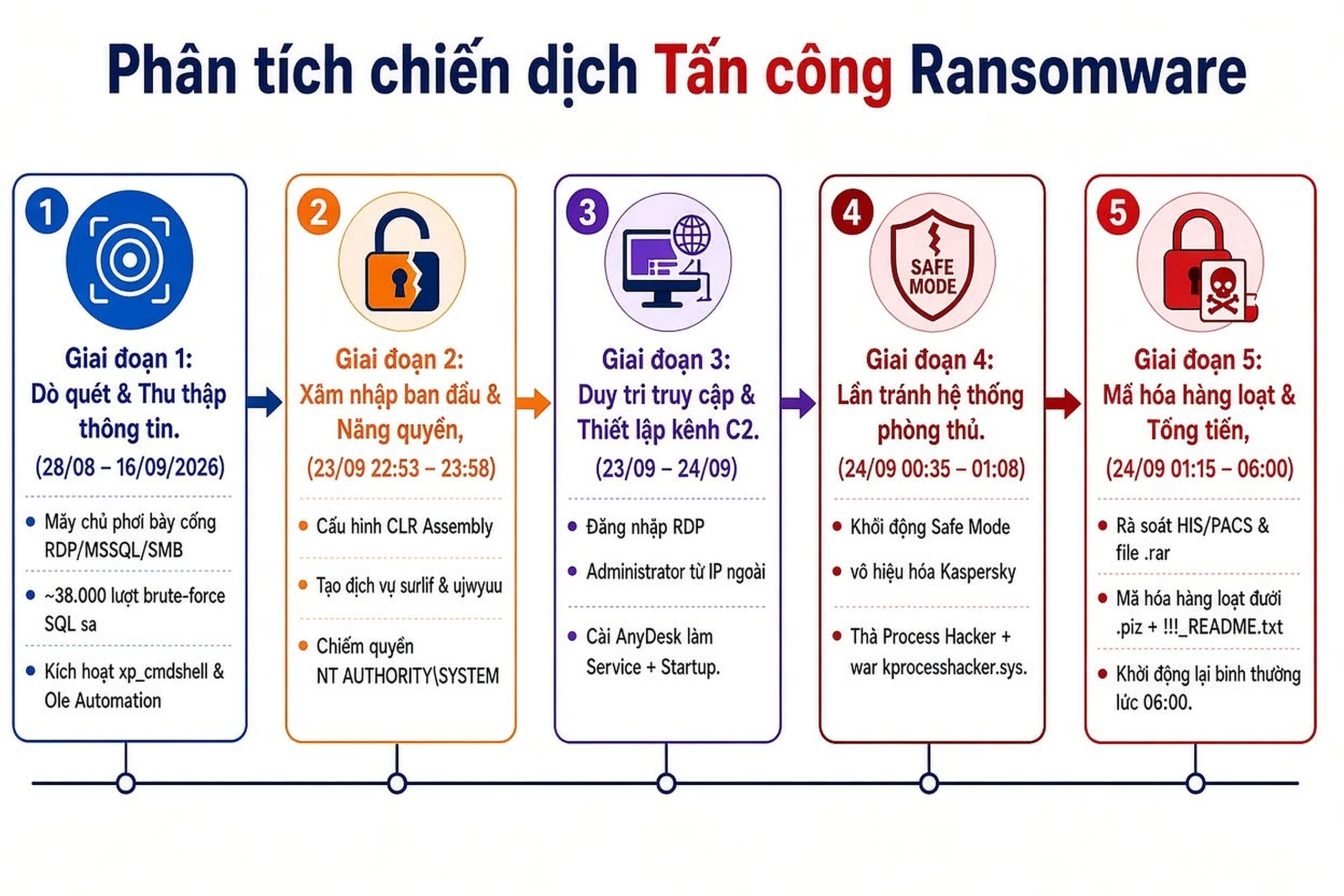
.piz extension itself. The critical signal is the attack chain that happened before encryption: exposed management services, credential attacks, SQL abuse, remote-access persistence, defense evasion and finally mass encryption.
sa brute-force attempts1. Incident Timeline
Scanning & reconnaissance
28 Aug – 16 Sep 2026. Public-facing RDP/MSSQL/SMB services were visible from the Internet. CyRadar reported roughly 38,000 brute-force attempts against SQL sa, together with activity around xp_cmdshell and OLE Automation.
Initial compromise & privilege escalation
23 Sep, 22:53–23:58. The source reports SQL CLR Assembly configuration, suspicious service creation and escalation to NT AUTHORITY\SYSTEM.
Persistence & remote control
23–24 Sep. Administrator RDP access from an external IP was observed, followed by AnyDesk installed as a Service and Startup item.
Defense evasion
24 Sep, 00:35–01:08. The server was booted into Safe Mode, security software was disabled, and Process Hacker plus a related driver were used to interfere with defensive processes.
Mass encryption & extortion
24 Sep, 01:15–06:00. Business data such as HIS/PACS and archives were reviewed, files were encrypted with the .piz extension, and a ransom note was left before the host returned to normal boot.
2. MSSQL as an Attack Surface
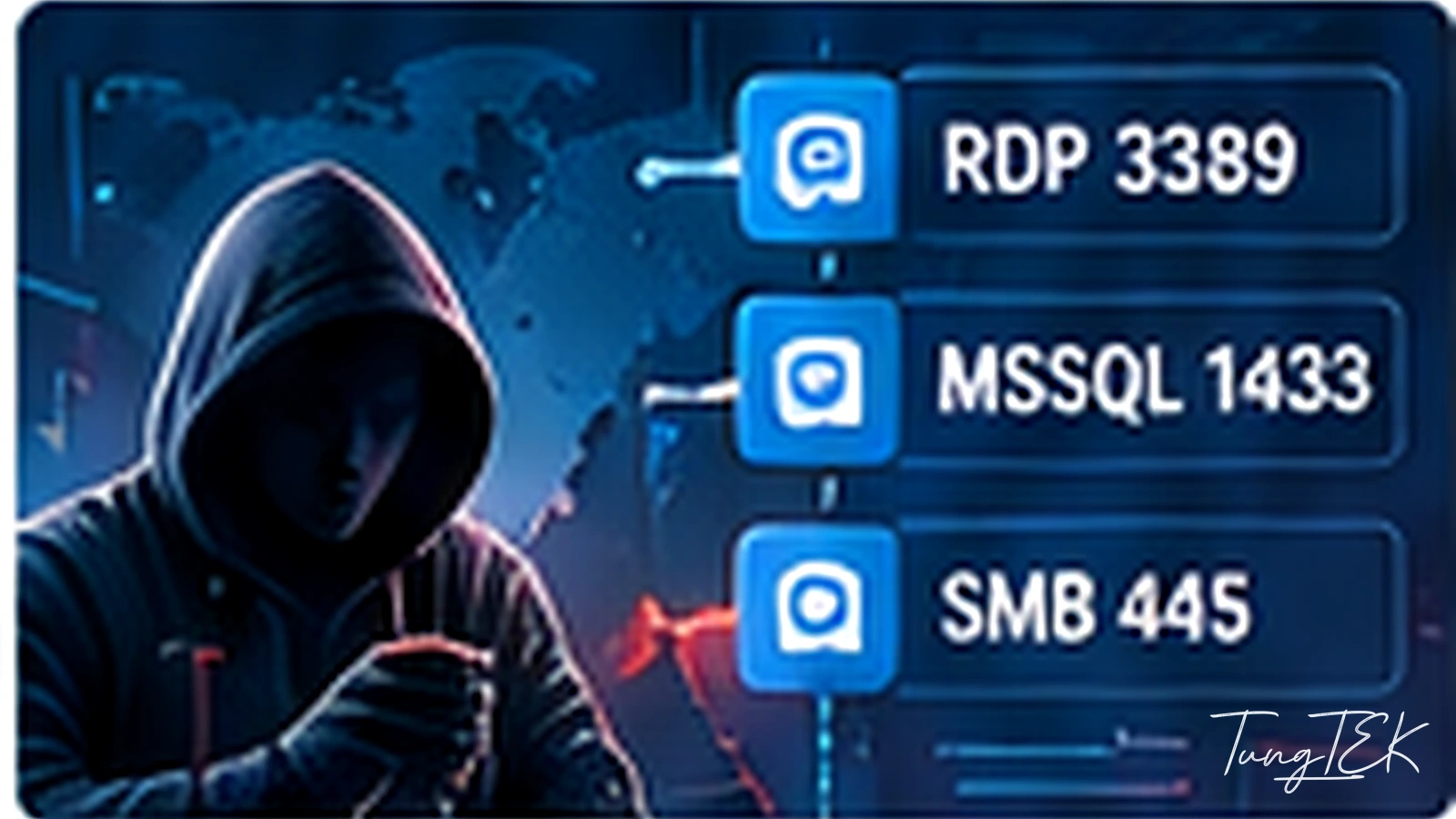
SQL Server is frequently embedded in ERP, HIS, accounting, manufacturing and line-of-business systems. The risk is not SQL Server itself but how it is deployed: direct Internet exposure, weak or reused credentials, oversized privileges and powerful administrative capabilities left available without sufficient monitoring.

xp_cmdshell and other administrative execution paths require strict privilege control and audit.CLR Assembly, xp_cmdshell and privilege boundaries
SQL CLR is a legitimate platform feature, but when an attacker obtains high database privileges it can become a route to execute code outside ordinary database operations. Likewise, xp_cmdshell can bridge SQL control into operating-system command execution. Hardening must therefore be based on least privilege, trusted assemblies, configuration auditing and controlled administrative access — not just a single on/off setting.
3. Remote Access as Persistence
AnyDesk is legitimate software. In an intrusion, however, installing a remote desktop tool as a service gives the operator a simple and persistent access channel. Organizations should maintain an allow-list of approved RMM tools and alert when new remote-control software, services or startup entries appear on critical servers.
4. Safe Mode and Defense Evasion
The key defensive lesson is correlation. A boot-configuration change, a security service being stopped, a new driver, external Administrator logon and an unapproved remote-access tool may each have benign explanations. When they occur close together, they form a much stronger ransomware precursor signal.
5. What the .PIZ Extension Does — and Does Not — Tell Us
.piz extension is an observed artefact, not sufficient evidence to identify a ransomware family by itself.For recovery work, the extension is only the starting point. What matters is how the file was transformed: whether the encryption is full-file or partial, whether headers or internal structures remain intact, whether database pages can still be parsed, and whether usable content can be extracted despite damaged regions.
6. Recovery Perspective: Why SQL Server Cases Need Separate Triage
Ransomware recovery is not always a binary “decrypt or fail” problem. Database files may contain structured regions that can sometimes be assessed independently. In SQL Server cases, technical triage should consider MDF/LDF page structure, database allocation, file growth patterns, encryption coverage and whether the attack altered, truncated or overwrote content in addition to encryption.
7. Ransomware Recovery by TUNGTEK
CuuDuLieuMaHoa.com by TUNGTEK is focused on ransomware-affected business data, especially cases where the operational priority is not “clean the server” but recover usable business data from damaged or encrypted storage.
For international partners, MSPs and incident-response teams: TUNGTEK can receive technical case information, sample encrypted files and storage details for initial assessment before physical media or full datasets are transferred.
8. Suggested Recovery Workflow
Collect ransom note, extension, system role, storage layout and business priorities.
Evaluate ransomware artefacts and representative encrypted files.
Separate incident-response needs from data-recovery objectives.
Work on copies/images where possible and prioritize usable business data.
Verify recovered output with application owners before final handover.
9. Defensive Priorities
- Do not expose RDP, MSSQL or SMB directly to the Internet unless there is a carefully controlled business requirement.
- Place administrative access behind VPN/ZTNA and MFA-enabled identity controls.
- Remove application dependence on
saor oversized SQL privileges wherever possible. - Audit CLR,
xp_cmdshell, SQL Agent, service creation and remote-access software on critical servers. - Correlate Safe Mode changes, security-service disablement, unusual Administrator logons and new RMM tools.
- Keep offline/immutable backups and test restoration instead of assuming a backup job equals recoverability.
10. Key Takeaway
Ransomware is often the final stage of an intrusion, not the first. By the time files carry a new extension, the attacker may already have spent hours or days obtaining credentials, escalating privileges, installing remote access and disabling defenses. Recovery therefore works best when incident-response evidence and data-recovery strategy are handled together rather than as two unrelated tasks.
🇻🇳 Tóm tắt tiếng Việt
Case CyRadar cho thấy ransomware .PIZ chỉ là giai đoạn cuối của chuỗi tấn công: dò quét MSSQL/RDP, brute-force, lạm dụng SQL CLR, cài AnyDesk, đưa máy vào Safe Mode, vô hiệu lớp bảo vệ rồi mới mã hóa dữ liệu. Với góc nhìn Recovery, không nên chỉ hỏi “có tool giải mã hay không”; cần đánh giá cấu trúc file, mức độ mã hóa, khả năng trích xuất dữ liệu còn dùng được và ưu tiên dữ liệu nghiệp vụ quan trọng.
Sources & Technical References
- CyRadar — original public case and attack-timeline infographic supplied with the source post.
- Microsoft Learn — SQL CLR Integration and Assembly security guidance.
- Microsoft Learn —
xp_cmdshellserver configuration guidance. - MITRE ATT&CK — Password Guessing, RDP, SQL Stored Procedures, Remote Desktop Software, Impair Defenses and Data Encrypted for Impact.
- CISA — #StopRansomware Guide and ransomware resilience guidance.