What is BlackNevas?
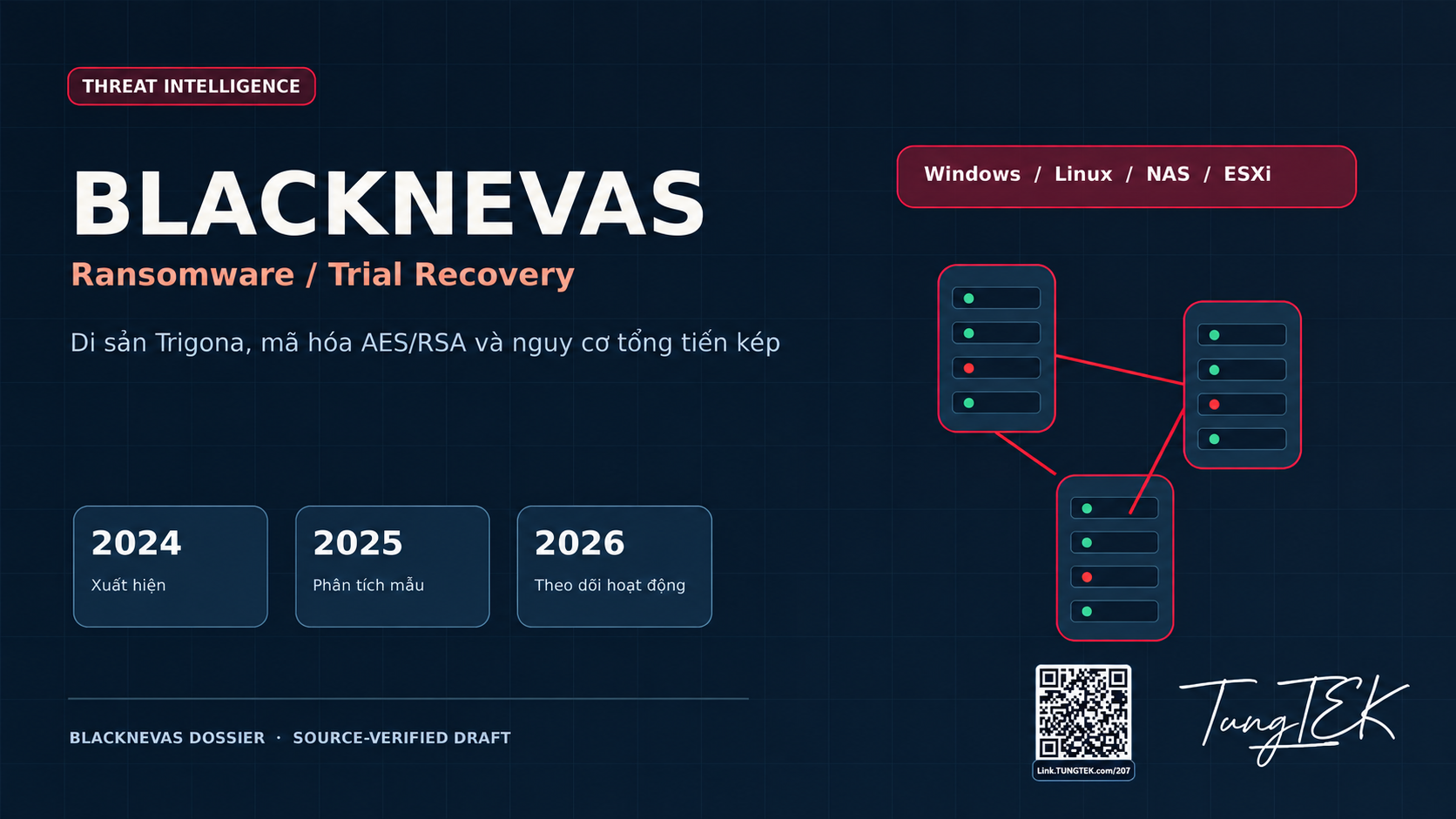
BlackNevas (also called Trial Recovery) is ransomware with technical links to the Trigona family, documented by researchers since late 2024. Publicly analyzed samples can run on Windows/Linux, with variants targeting NAS and VMware ESXi. File names may end in .-encrypted; a commonly observed ransom note is how_to_decrypt.txt. These signs must be corroborated with file contents and server artifacts. [S1][S2]
The first step when encrypted files are discovered is not to try multiple decryption tools. The priority is to prevent changes to the original data, contain the affected scope, and preserve evidence to assess the appropriate recovery path.
How much of a file does BlackNevas encrypt?
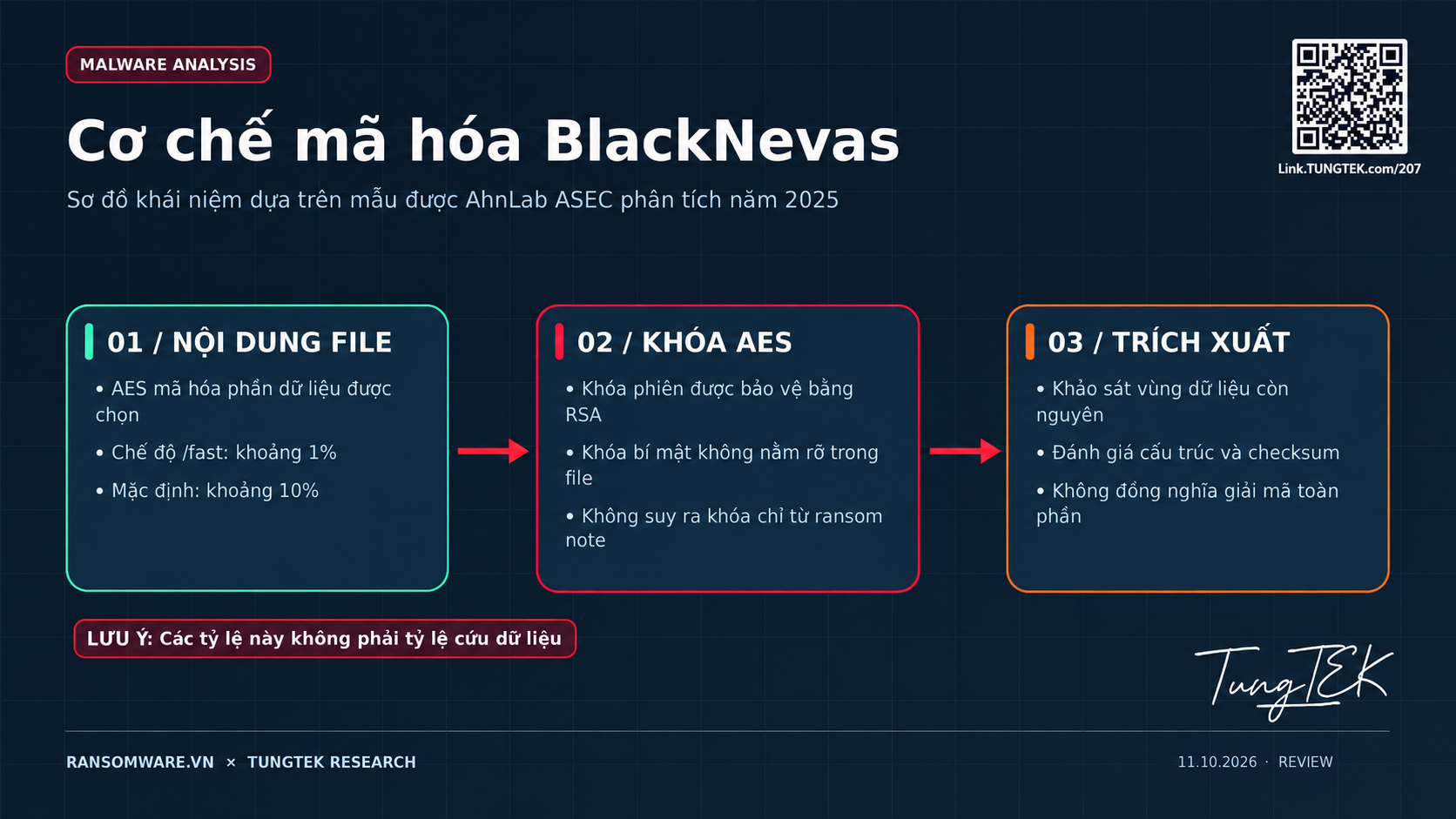
A technical examination by AhnLab ASEC documented /fast (approximately 1% encryption), the default mode (roughly the first 10% of a file), and /full (full encryption) in its analyzed sample. Encrypting only 10% does not establish that 90% can be recovered. Intact bytes may be unusable if the damaged region contains metadata, index trees, headers, allocation tables, or other critical structures. Behavior can also vary across builds and versions. [S1]
MDF/LDF, VMDK/VHDX, ZIP, PST, and application databases each require independent structural examination. A file may open while still missing tables, containing corrupt pages, broken data relationships, or stale content. Recovery results must therefore be validated against business requirements, rather than judged solely by the number of extracted files.
Six safe response steps for a BlackNevas incident
Step 1 — Contain and isolate
Disconnect network paths to affected systems where possible. Examine servers, NAS, virtualization infrastructure, administrator accounts, and systems sharing access rights. Avoid immediately restarting systems in bulk: memory-resident artifacts can be lost. If network isolation is impossible and encryption continues, a shutdown decision must reflect the urgency of the incident. [S6]
Step 2 — Preserve encrypted data and ransom notes
Do not delete notes or rename or overwrite files in bulk. Preserve directory structure, timestamps, permissions, relevant snapshots, Windows logs, EDR, firewall and VPN logs, and hypervisor/NAS events. Acquire forensic copies and compute hashes before analysis.
Step 3 — Identify the variant and affected scope
Correlate notes, file structure, extensions, sample hashes, and log indicators. Determine whether servers were fully or partially encrypted, whether virtual machines were stopped, and whether database files were open during the incident. These findings determine the recovery method and resources required.
Step 4 — Assess potential recovery sources
Prioritize offline/immutable backups that have been checked for safety. Next assess pre-encryption copies, valid snapshots, version history, and other application data copies. Only then consider extracting data from unencrypted byte ranges — using working copies, with methods appropriate to each format.
Step 5 — Validate files and business data
Open files in their original applications. For SQL, use DBCC/integrity checks and confirming queries. Inspect the contents of images and documents. Start recovered VMs in an isolated environment and validate application data. Do not reconnect production networking before the reinfection risk has been addressed.
Step 6 — Investigate the cause and rebuild clean systems
Recovering data without addressing stolen access or persistence can lead to reinfection. After recovery, verify MFA, replace keys/credentials, review RDP/VPN and permissions, protect backups, and monitor unusual activity in line with incident-response guidance. [S6]
Three concepts that are often confused
| Concept | Expected outcome | Conditions and limits |
|---|---|---|
| Decryption | Restore plaintext using a valid key/algorithm | Usually requires the correct key or a verified cryptographic weakness |
| Encrypted data extraction | Attempt to recover intact data or reconstruct structures | Depends on scope, format, fragmentation, and metadata |
| Backup restoration | Recover clean data from before the incident | Requires intact backups, restore testing, and a clean environment |
There is no fixed formula for converting the percentage of an encrypted file into a recovery percentage. With archives, disk images, databases, and specialized applications, a small amount of damage in a critical location may render most data unreadable.
Is there a free BlackNevas decryptor?
Within the public sources checked at the editorial cutoff, this review did not verify a dedicated free tool capable of universally decrypting BlackNevas. This can change: check announcements from Emsisoft, No More Ransom, and reputable security researchers. Avoid fake “free decryptor” websites and never test tools on original data. [S7]
Does a seven-day ransom deadline mean permanent loss?
Some BlackNevas notes threaten key deletion or disclosure after seven days. This is criminal messaging; it is not a verified technical timeline for every victim. Paying also does not guarantee a working tool, intact data, or deletion of stolen information. [S1][S6]
How can TRecovery by TUNGTEK help?
For suspected BlackNevas incidents, TRecovery by TUNGTEK assesses evidence and recovery feasibility before proposing a solution: RFC – Ransomware Fast Check, encryption indicator identification, file structure examination, backup/snapshot assessment, investigation of extraction options, and prioritization of critical systems. Specialized work is conducted only within the customer-approved scope and on appropriately preserved data sources.
We do not promise a decryption key, publish success rates before examination, or treat ransom payment as the default solution. The objective is a qualified technical conclusion and a verifiable damage-reduction plan.
🧿 TRecovery by TUNGTEK — Ransomware Recovery
📣 Zalo/Hotline: 0963 509 115
🌐 https://cuudulieumahoa.com
🇻🇳 Data incident? Contact TUNGTEK.
Frequently asked questions
1. Does the .-encrypted extension prove BlackNevas? No. Corroborate it with a note, file structure, or other artifacts.
2. Can I rename files and try opening them? Avoid changing originals. Preserve them and create copies before testing.
3. Can partially encrypted data be recovered completely? It may or may not, depending on format, affected block locations, metadata, and data relationships.
4. What should a customer provide initially? System/device information, important file types, a sample note, representative encrypted files, an incident timeline, and backup status. Exchange them through a secure channel rather than distributing sensitive data publicly.
5. Should I pay the attackers? This is a high-risk decision requiring legal, security, and business-continuity assessment. There is no guarantee of decryption or deletion of stolen data.
Background threat analysis
In-depth BlackNevas analysis on Ransomware.VN: https://link.tungtek.com/207